OHBM 2023 · Oral · Naturalistic fMRI · Tensor methods
Brain networks via tensor decomposition
Identifying shared brain networks in a clinically rich dataset using NASCAR tensor decomposition on naturalistic movie-viewing and resting-state fMRI—without the independence constraints of conventional ICA.
- Venue
- OHBM 2023 · Oral session
- Methods
- NASCAR tensor decomposition · Gale–Shapley matching
- Data
- Naturalistic movies · resting-state · clinical cohort
- Role
- Speaker · lead presenter
Overview
Much of our knowledge of cognition comes from experiments with highly controlled stimuli. Everyday life is richer and more dynamic, and naturalistic stimuli have gained traction as a more ecologically valid way to study the brain. These paradigms are often used to examine shared responses across groups, but less work has targeted individual differences and heterogeneous clinical populations—including people with autism spectrum condition (ASC), who show altered audiovisual perception and social communication.
Naturalistic data are also well suited to data-driven network identification. Independent component analysis (ICA) is an influential tool for finding brain networks, applied either per subject or after concatenating data temporally or spatially for group analysis (Calhoun et al., 2009). That concatenation into a 2D representation can discard low-rank structure shared across subjects, and ICA’s assumed spatial or temporal independence may not match biology given the extensive overlap between networks in space and time.
Approach
An alternative is NASCAR—a stable, robust method for identifying brain networks and their temporal dynamics across subjects using tensor decomposition (Li et al., 2021), without imposing independence constraints.
In this work we applied NASCAR to fMRI during naturalistic stimulation and at rest in a clinically rich dataset, linking resting-state and movie-driven components and relating temporal modes to stimulus features.
Supplementary figures
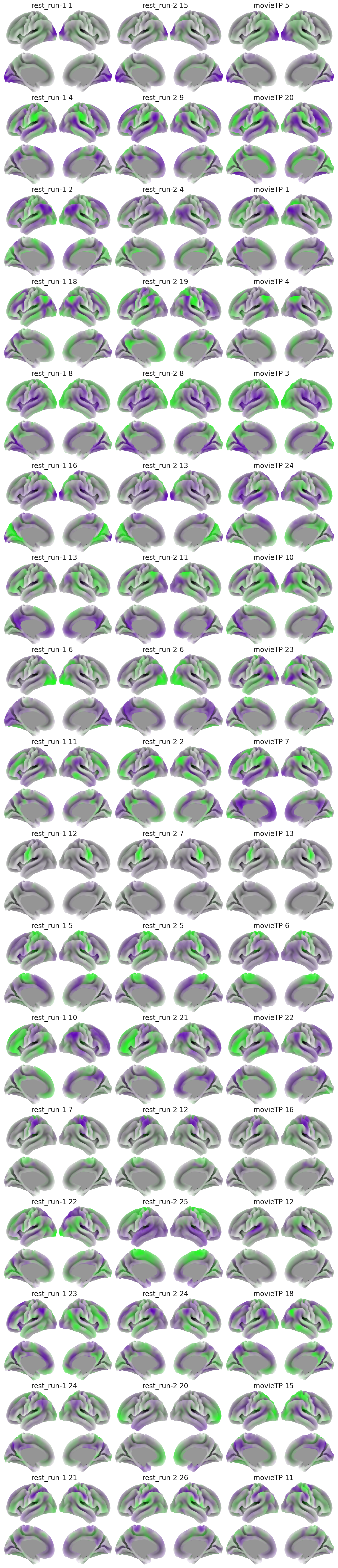
Gale–Shapley matched spatial components from resting state (columns 1 and 2) and the movie The Present.
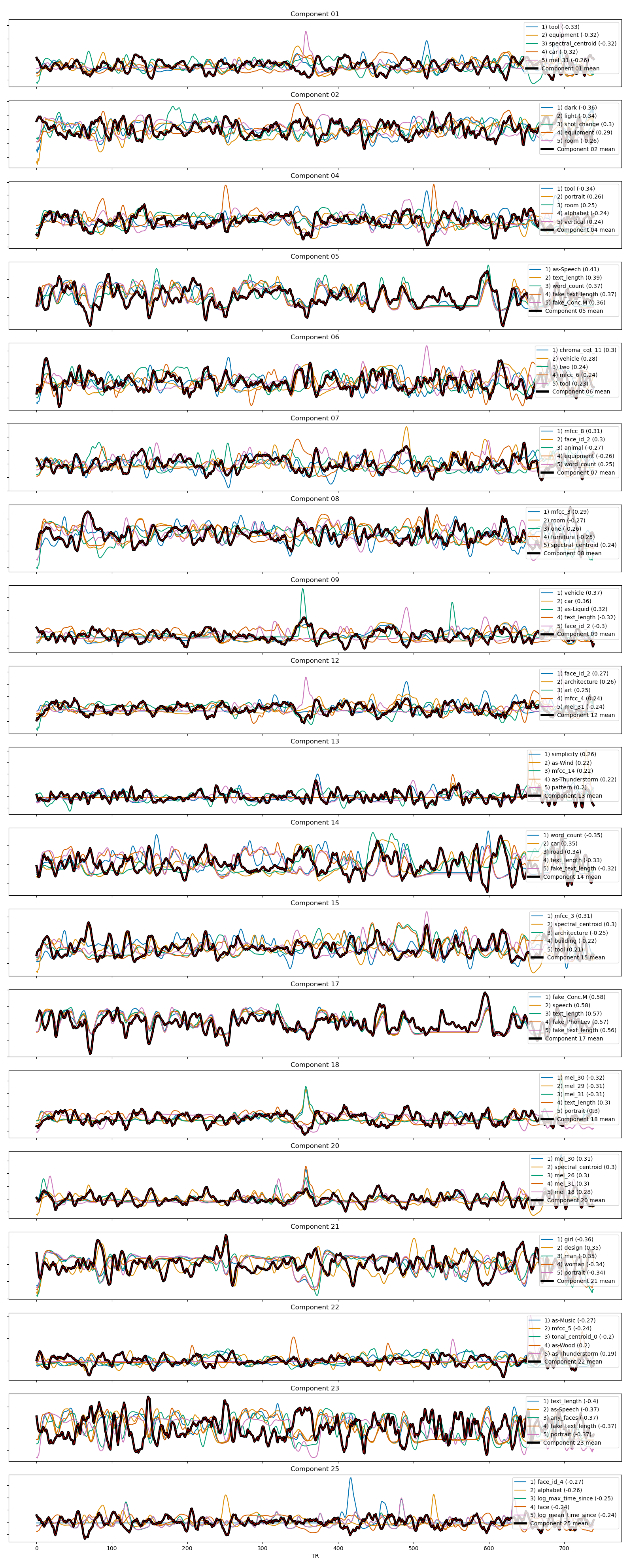
Temporal modes from Despicable Me with the five most highly correlated movie features for each component.
Collaborators & related links
- Senseable Intelligence Group — research home for this work
- Jian Li (Andrew) — developed the NASCAR method; see his papers and well-documented Matlab code to try it
- Satra Ghosh — supervisory team
Poster, slides, and additional figures are in the ohbm_2023 repository.
My role
Speaker for the OHBM 2023 oral session. I presented the tensor-decomposition analysis of naturalistic and resting-state fMRI in a clinically rich cohort and prepared the poster and talk materials linked above.